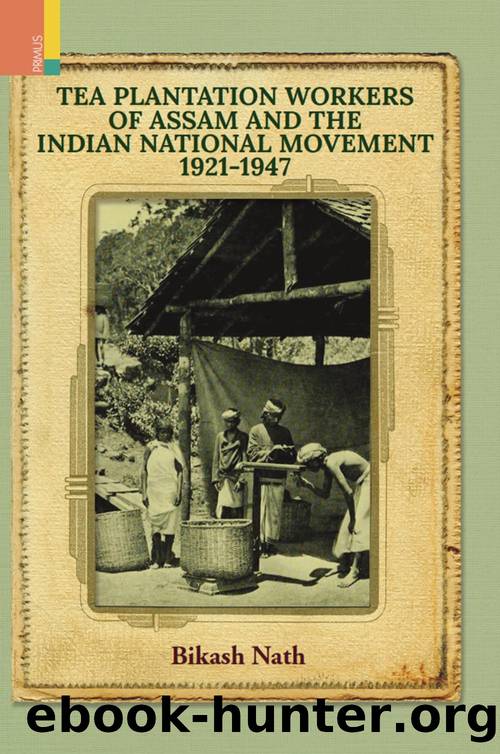
Tea Plantation Workers of Assam and the Indian National Movement, 1921-1947 by Bikash Nath
Author:Bikash Nath [Nath, Bikash]
Language: eng
Format: epub
Publisher: Primus Books
Published: 2016-10-17T00:00:00+00:00
NOTES
1.Bhikhu Parekh, The Marxist Discourse on Gandhi, in Business and Politics in India, ed. Dwijendra Tripathi, Delhi, 1991, p. 210.
2.R.P. Dutt, India Today, Calcutta, 1997, p. 386.
3.âChairmanâs Speech at the Fortieth Annual General Meeting of the ITAâ, held on 11 March 1921 (Royal Exchange Building, Calcutta) in Report for the Year 1920: ITA, Calcutta.
4.Ibid.
5.Census of India, 1921, vol. III/Assam, pt. I, p. 5.
6.Some tea estates even during the depression paid heavy dividends. For instance, the Pabhojan Tea Company paid a dividend of 35 per cent in 1918 and 1919 and 25 per cent in the disastrous year 1920. The Doom Dooma Company paid a dividend of 15 per cent in 1918 and 1919 and 10 per cent in 1920, ALEC Report, 1921â22, p. 7.
7.Ibid., pp. 7â8.
8.Ibid.
9.Ibid., p. 6.
10.Ibid., pp. 6â7.
11.Ibid., p. 7.
12.Ibid., p. 9.
13.Ibid., p. 110.
14.Statement given by Babu Lalit Mohan Chaudhuri before the ALEC Report, 1921â22, Evidence, p. 65.
15.ALEC Report, pp. 15â16.
16.ALEC, Evidence, p. 150.
17.Deveshwar Sharma, Herai Jowa Dinbor, Guwahati, 1980, p. 145.
18.Royal Commission on Labour in India, vol.VI, pt. I, London, 1930, p. 6.
19.Pande in his speech, also compared the tea garden managers to Satan and he further stated that the English nation had seized Indian by foul means and that now Swaraj could be attained through noncooperation. In his second meeting too, he reiterated the demands he had made at the first meeting and said that if their grievances were not redressed, they should cease work like the coolies of the Khoreal Tea Estate in Cachar. ALEC Report, 1921â22, p. 11.
20.The case was that a European planter wanted to live with a coolie girl and,on being refused shot her father with a revolver.The accused was acquitted by the Calcutta court on the verdict of a jury of nine of whom eight were Europeans. The Mussalman Calcutta, 5 March and 1 July 1921, cited in A. Guha, âFormation of a Working Class in Assam Plantationsâ, in The North Eastern Affairs, vol. 5, nos. 1 and 2, Annual 1976, Shillong.
21.Ibid., p. 13.
22.Quoted in ibid., p. 12.
23.Ibid.
24.ALEC 1921â22, Evidence, p. 224.
25.Evidence given by J.A. Milligan, Chairman, Assam Labour Board in ibid.
26.The report also observed that âin the valley (Surma Valley), recruiting in 1918â19 had been unusually heavy and the class of coolie imported in that year under famine conditions is a matter of notorietyâ, ALEC Report, p. 12.
27.Ibid.
28.Ibid.
29.Ibid.
30.Ibid., p. 13.
31.âAn examination of the registers for August 1920 at Oliviacherra garden (Goombhira division) disclosed the fact that in the height of the plucking season, too gangs comprising inferior workers and new coolies were only earning on an average Rs.3â8 a month as against Rs.7â8 and over, earned by the best workers. In these two gangs, there were a large number of women earning 2 annas 3 pies a day, and many earning only one 6 pies.â Ibid.
32.Evidence by Mukerjee in ALEC Report, 1921â22, Evidence, p. 61.
33.Quoted in ibid., p. 14.
34.Ibid., pp. 14â15.
35.A. Guha, Planter Raj to Swaraj, Delhi, 1991, p. 128.
36.Evidence given by W.R.P. Gunnery, Manager, Chargola Division before the members of the Assam Labour Enquiry Committee, 1921â2 in ALEC, Evidence, p.
Download
This site does not store any files on its server. We only index and link to content provided by other sites. Please contact the content providers to delete copyright contents if any and email us, we'll remove relevant links or contents immediately.
| Anthropology | Archaeology |
| Philosophy | Politics & Government |
| Social Sciences | Sociology |
| Women's Studies |
The Secret History by Donna Tartt(19088)
The Social Justice Warrior Handbook by Lisa De Pasquale(12190)
Thirteen Reasons Why by Jay Asher(8909)
This Is How You Lose Her by Junot Diaz(6886)
Weapons of Math Destruction by Cathy O'Neil(6279)
Zero to One by Peter Thiel(5802)
Beartown by Fredrik Backman(5754)
The Myth of the Strong Leader by Archie Brown(5507)
The Fire Next Time by James Baldwin(5444)
How Democracies Die by Steven Levitsky & Daniel Ziblatt(5218)
Promise Me, Dad by Joe Biden(5153)
Stone's Rules by Roger Stone(5088)
A Higher Loyalty: Truth, Lies, and Leadership by James Comey(4963)
100 Deadly Skills by Clint Emerson(4925)
Rise and Kill First by Ronen Bergman(4788)
Secrecy World by Jake Bernstein(4753)
The David Icke Guide to the Global Conspiracy (and how to end it) by David Icke(4718)
The Farm by Tom Rob Smith(4509)
The Doomsday Machine by Daniel Ellsberg(4490)
